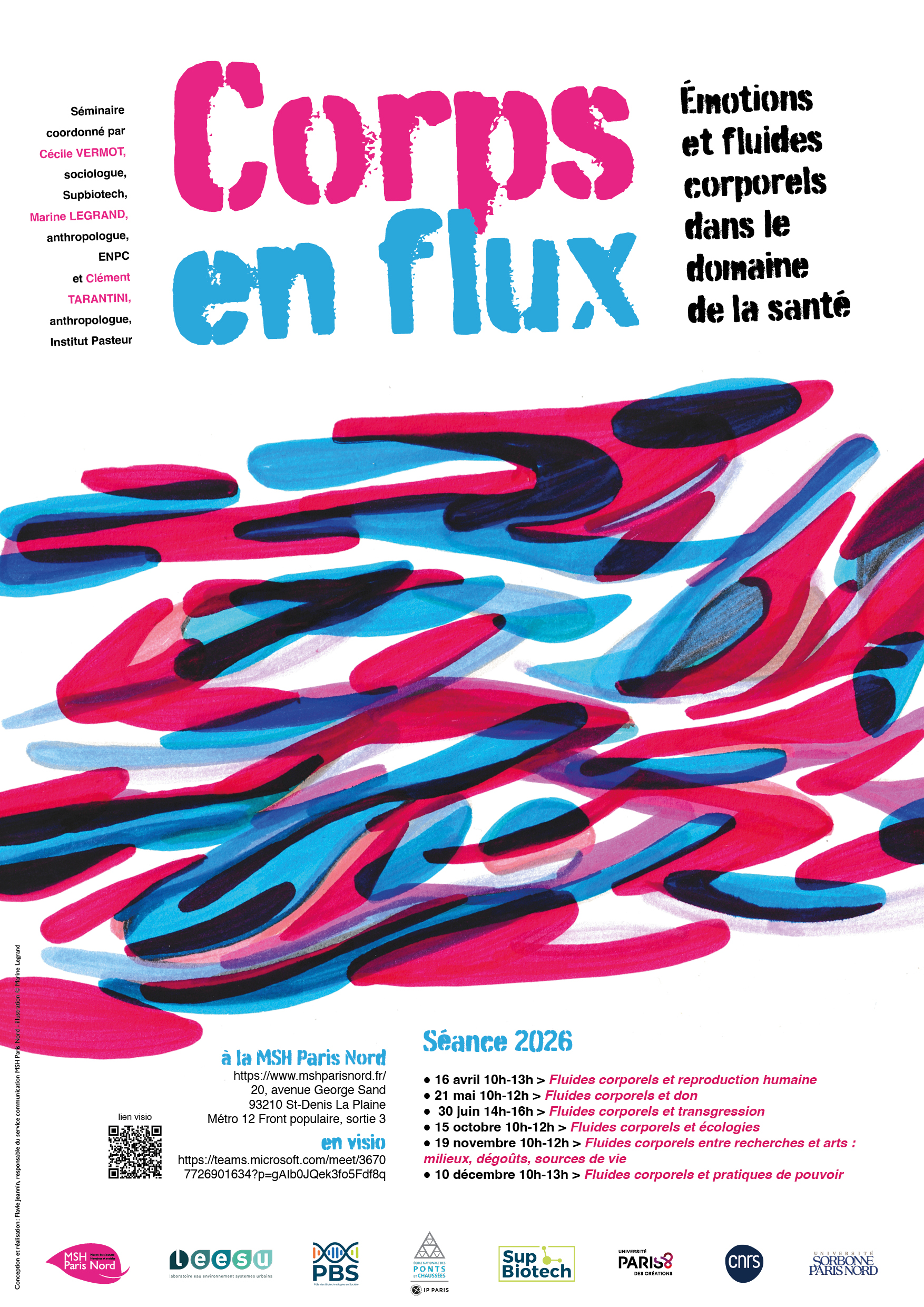

Workshop | L’usure : fatigue, soin et politiques de la vulnérabilité

Worn Out: Fatigue, Care and the Politics of Debility
First writing workshop (journée d’études), supported by the MSH Paris Nord, to co-develop a special issue for the journal Société & Santé, with interdisciplinary article contributions across the anthropology of the body and medical sociology.
Fatigue is now ordinary across health systems, reception regimes, retrenched welfare states and platform labour. It is usually read either as individual pathology (burnout, chronic fatigue) or as the malaise of the neoliberal self (Ehrenberg 1998). The first separates tired bodies from the institutions that tire them. The second tells us everyone is tired, but not who is made tired for whom, whose tiredness is believed, or what tired people go on to do. We treat fatigue as relational, unevenly distributed, historically produced and generative.
« Polarised » covers two meanings. Politically, care is a battleground over who deserves it, who pays for it and who may offer it: welfare chauvinism, public-health conflicts, criminalised solidarity with migrants. Relationally, exhausted bodies are held between opposing pulls (solidarity and self-protection, empathy and indifference, autonomy and dependence), while rest gathers at one pole and depletion at the other.
In scope: ethnographic, qualitative, historical and conceptual work on how fatigue is lived, attributed, contested or organised, including reflexive work on researching exhaustion. Out of scope: clinical measurement, epidemiology and burnout prevention; wellness and resilience discourses only as objects of critique.
Theoretical framework
- A vocabulary. We keep apart terms often used as synonyms. Deleuze (1992) separates the tired, who has used up what could be realised, from the exhausted, who has used up the possible itself. Depletion names the cost of social reproduction when what is drained is not replenished (Rai, Hoskyns and Thomas 2014). Debility names a slow wearing-down of populations that is a mode of power rather than its accident (Puar 2017).
- A genealogy. Nineteenth-century science recast the worker as a « human motor » whose fatigue limited output (Rabinbach 1990). This history was racialised from the start: Fanon (1952) and Sayad (1999) show clinics disbelieving migrant pain and treating the sick immigrant body as a breach of its reason for being there. Whose fatigue is believed remains an open, political question.
- Distribution. Berlant (2007) describes « slow death » as the ordinary wearing-out of populations; Povinelli (2011) shows how late liberalism allocates endurance and exhaustion to those it abandons. Fraser (2016) locates a structural contradiction: capitalism depends on social reproduction while depleting it. Vergès (2019) shows whose bodies absorb it, as racialised women’s invisible cleaning and care keep other bodies rested.
- Ambivalence. Care is often a source of fatigue, not its opposite. Beyond care as practical tinkering (Mol 2008), ethico-political obligation (Puig de la Bellacasa 2017) and democratic responsibility (Tronto 1993), care can discipline, select and exclude (Ticktin 2011; Lachenal 2022). Francophone sociology of work adds a mechanism: collective defences against suffering, indifference included (Dejours 1998), and the invisibilisation of care work (Molinier 2013). This helps explain why empathy and indifference coexist in exhausted bodies.
- Generativity. Exhaustion also produces things. Berlant’s « lateral agency » names small acts of maintenance and self-interruption rather than heroic resistance; disability justice offers collective access and care webs (Piepzna-Samarasinha 2018). We ask whether exhaustion can ground solidarity, or mostly produces withdrawal.
The workshop and next steps
The meeting is a writing workshop in three moments:
- Mapping: each participant briefly presents their field and how fatigue, care and debility emerge within it.
- Pitches: each contributor presents a proposed article in five pitch slides (central argument, material, strand, and the concept it tests or extends) and receives feedback from the convenors and peers.
- Synthesis: a collective discussion of shared concepts and cross-cutting themes, to shape the issue’s structure and introduction.
Before the workshop, each contributor sends the convenors a 250-word abstract of their proposed article by Monday 16 November. Drafts will then circulate between meetings: the second workshop, in May 2027, will discuss full draft articles with discussants appointed by the MSH Paris Nord, and finalise the issue.
Informations pratiques/Practical information
- jeudi 20 novembre 2026, de 9h à 13h
- à la MSH Paris Nord et en ligne via Webex
- workshop en anglais
- ouvert à tous·tes
Un projet de recherche qui bénéficie du soutien de la MSH Paris Nord dans le cadre de son appel à projets annuel.